An invoice exception has been explained. The discrepancy is clear, the supporting documents are available and someone knows the next step.
The case is still open.
A supplier may need to correct the invoice. A reviewer may need to confirm the treatment. The relevant record must reflect the outcome, and the team needs to know whether the correction actually arrived.
Unified Execution means coordinating those steps as one controlled workflow, from the incoming signal to a verified outcome. It is the third of Symplichain’s three pillars, connecting intelligence and context to the systems where work happens.
The starting point is a clear definition of what “complete” means.
Consider an illustrative invoice discrepancy. The invoice shows a charge that the selected agreement does not support.
An AI-generated explanation can help the reviewer understand it. A drafted supplier message can help prepare the next action. Neither proves that the invoice has been corrected.
Depending on the process, completion may require a corrected invoice or an approved disposition, an updated case record and evidence that the responsible owner accepts the result.
Make that definition explicit before designing the workflow. Otherwise, successful intermediate steps can be mistaken for a resolved exception.
| Workflow state | What it tells the team |
|---|---|
| Evidence gathered | The relevant documents and records are available for review. |
| Next step proposed | The workflow has prepared an action and its basis. |
| Waiting for approval | A named person must decide before it proceeds. |
| Action attempted | An authorised operation has been sent to a supported system. |
| Outcome verified | The expected result has been checked against the completion criteria. |
A case can also remain unresolved. That state should have a reason, an owner and a next step rather than disappearing from view.
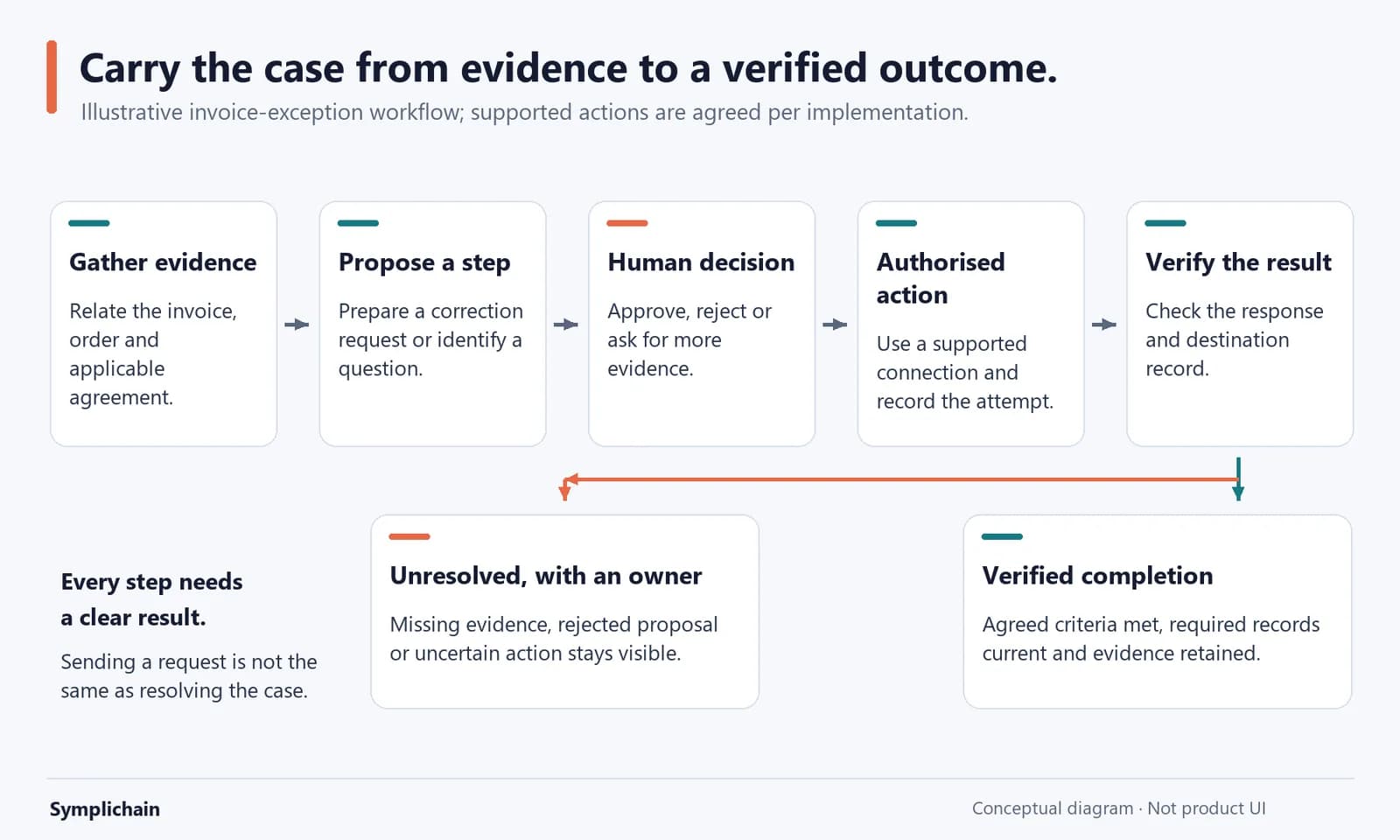
Illustrative invoice-exception path. Approval comes before the authorised action; a case closes only when its agreed criteria are met. A missing source, rejection or uncertain action should hold the affected step.
Operational workflows cross several boundaries: documents, business systems, people and external parties.
If each handoff carries only an instruction, the next person must rebuild the reasoning. “Ask the supplier to correct this” leaves the recipient searching for the invoice, the agreement and the relevant charge.
A useful case carries the proposed action together with the records supporting it, the unresolved questions and the decision owner. That makes review easier and reduces the chance of acting on an incomplete interpretation.
This is where Portable Context matters. The workflow needs to understand which agreement applies and why the proposed action follows from it. A faster model cannot compensate for the wrong commercial terms.
In Symplichain, these responsibilities are distributed across the platform:
- SymConnect™ links business software and operational sources. Supported operations vary by product and integration.
- SymConductor™ coordinates workflow steps, dependencies and the points where work waits for a decision.
- SymTrust™ provides governance around source access, permitted tools and approval requirements.
- SymPulse™ brings visibility into AI activity and the steps behind a workflow outcome.
SymMirror™ is the agentic workflow family; SymFlow™ provides the connection, governance and observability layer around the work.
For the invoice example, a defined workflow could retrieve the evidence, compare the charge with the agreement, prepare a correction request, pause for the required approval and send it through a supported connection. It would then track the case towards its agreed completion criteria.
The particular actions, notifications and approval behaviour must be confirmed for the implementation. Reading a record, drafting a message, sending it and updating a business system are separate permissions.
Return to the illustrative invoice discrepancy. A supplier has billed a charge that the selected agreement does not appear to support. The operation needs a resolution, with the right evidence and approval attached.
First, identify the case. Connect the incoming invoice to the relevant order and supplier. If the relationship is unclear, ask for clarification before interpreting it as a known exception. A plausible match is not enough when the wrong case could lead to the wrong communication or update.
Next, assemble the evidence. Bring together the invoice, applicable agreement and records needed to interpret the charge. Check whether an amendment or a prior approved exception changes the picture. Record missing material rather than treating its absence as proof that the charge is invalid.
Then, propose the next step. If the evidence supports a discrepancy, prepare a correction request with the disputed item and its basis. If it remains ambiguous, propose a question for the supplier or decision owner instead. The workflow should be able to distinguish a supported finding from an investigation still in progress.
Obtain the required decision. Show the reviewer the proposed communication, supporting passages and unresolved questions. The reviewer may approve the request, reject its interpretation or ask for more evidence. Preserve that decision so the next stage does not reconstruct it from a chat thread.
Carry the authorised action forward. Send the approved request through a supported connection and record what happened. A message accepted by a sending system does not establish that the supplier agreed with it or corrected the invoice.
Verify the disposition. When a response arrives, relate it to the same case. Check the corrected document or the approved treatment against the agreed completion criteria. Confirm any required record update and retain the evidence supporting closure.
This sequence shows why one successful prompt is only a step. The case includes interpretation, waiting, external response, review and confirmation. Each stage needs a clear result before the dependent work can proceed.
An agent can assemble evidence and prepare the next step without being authorised to make every commercial decision.
For example, a workflow might be permitted to identify a discrepancy and draft a supplier message. Accepting an additional charge or changing a payment term may require a person.
The approval should show what is proposed, the supporting sources and anything still uncertain. It should also identify who can decide. If that person is unavailable, the workflow needs a defined waiting or escalation path.
The point of an approval is an informed decision. A button without enough evidence simply moves the reconstruction work onto the reviewer.
An invoice may be unreadable. A system may be unavailable. The supplier may send the same message twice. An update may return an ambiguous result.
These are practical workflow conditions, so define their treatment before rollout:
Missing evidence: identify the missing source and hold the dependent decision.
No response: set a waiting limit and route the case to an owner when it expires.
Duplicate events: recognise an existing case before creating another action.
Uncertain update: inspect the destination before repeating a write that could create a duplicate.
Rejected proposal: preserve the decision and explain what happens next.
SymConductor’s workflow model includes defined retry, timeout and escalation behaviour. The supported patterns are agreed for the deployment. Reviewing or replaying a run is also different from undoing an external action; reversing a change needs its own support and authorisation.
An approval request should reduce the work needed to decide. It should not merely announce that an agent has reached a pause.
For the invoice example, the reviewer needs to see the disputed item, the relevant term, the proposed supplier message and the consequence of approving it. If a record will change, show the current value and the proposed value. If a question remains open, put it beside the proposal rather than burying it in a long history.
Name the decision owner and define the alternatives. “Approve the correction request” is different from “accept the charge.” If the workflow supports rejection or requests for clarification, specify how those decisions affect the case. A rejected proposal may need revision; an unresolved commercial question may need escalation.
Also define how long a pending decision can wait and who owns follow-up. This is especially important when the supplier or another team is waiting on the result. A controlled pause is useful when its state is visible and its responsibility is clear.
The exact approval interface and notification behaviour depend on the implementation. The design principle is consistent: the person should understand what will happen, why it is proposed and what remains uncertain before authorising it.
Some cases are poor candidates for agentic execution until the process around them improves.
If nobody can establish which agreement applies, an automated follow-up may make the confusion harder to unwind. If ownership changes from case to case without a clear rule, an approval can circulate without a decision. If the destination system cannot safely support the intended action, the workflow may need to stop at a reviewed recommendation.
Start by narrowing the scope. A first implementation might gather evidence and prepare a case for review. A later stage could add an approved communication action once the team has tested the evidence and decision path. Supported record updates can follow when their permissions, confirmation and failure handling are clear.
That sequence gives the operation a way to learn without assuming the entire process must become autonomous at once. It also keeps value measurable: time saved assembling a decision-ready case is useful, even when a person still makes the commercial decision.
Avoid measuring that narrower workflow as though it owns the whole outcome. If its agreed responsibility ends at preparing the evidence, assess the quality and effort of that preparation. If it owns follow-through to closure, include waiting, unresolved cases and reopening in the review.
Model response time and usage cost help you understand AI activity. Operational value requires another view: what happened to the work?
For an invoice-exception pilot, compare a baseline with the agreed trial period. Track time to resolution, human handling effort, cases reopened because of errors and the proportion of cases with a verified outcome. Keep unresolved cases in the denominator and inspect the reasons they stalled.
Do not count a drafted message as a resolved invoice. Do not treat time released as cash savings unless you can establish the financial effect.
These are suggested pilot measures, not reported Symplichain customer results. They help a team decide whether to keep, change or expand a workflow.
A successful demonstration often follows the cleanest path. An implementation review should include conditions that challenge the workflow's boundaries.
Try an invoice with no matching order, a duplicate supplier message and an amendment that changes the apparent interpretation. Try a reviewer rejecting the proposed action. Test a destination that does not respond clearly, then check whether the workflow records an unresolved state instead of reporting completion.
For each case, write the expected behaviour before running it. Which step can continue? What evidence is missing? Who should be notified? Which actions must remain unattempted? What record should the team be able to inspect afterwards?
This creates a useful acceptance test for the process. A workflow that correctly pauses when it lacks authority may be behaving better than one that confidently carries on. Include those correct pauses in the review, while distinguishing them from avoidable failures caused by poor source access or an incomplete design.
Use what the team learns to adjust scope, sources and approval rules before widening the rollout. Confirm the actual supported behaviour with the implementation owner; the tests are proposed evaluation practices, not a claim that every deployment has already passed them.
Pick a recurring exception with accessible evidence, a clear owner and an observable finish. Map its trigger, sources, permitted actions, approvals, failure paths and completion criteria.
Then test ordinary cases and cases that should stop. That gives you a practical way to assess whether the workflow carries work responsibly from one stage to the next.
Bring the map to a Symplichain demo. We can explore the supported connections and decision boundaries around your workflow.
A connection provides access to supported information or operations. Unified execution adds coordination: shared case context, ordered steps, approvals, failure handling and a definition of completion.
Symplichain is designed to work across existing business systems. The available reads, writes and communication actions depend on the integration, product and implementation.
Define approvals around the consequences and uncertainty of each step. Routine evidence gathering may be permitted while commercial decisions, external messages or record changes have explicit review boundaries.
- Finance and AP
- Coordination
- Exceptions
- Agent safety