Two documents show different delivery terms. Both look plausible. One is the original agreement; the other is a current amendment.
The useful answer depends on knowing how those documents relate, which one applies and whether the person asking is allowed to use them.
That is operational context: the information and relationships that make a fact meaningful for your business.
Portable Context means keeping control of that knowledge as your models and platforms change. It is one of Symplichain’s three pillars, because the understanding an operation builds should remain an asset of the business.
Supply chain work creates more than records. It creates an understanding of what happened, why a decision was made and what should happen next.
Consider an illustrative procurement scenario. A team accepts a temporary delivery arrangement because a particular production line can use substitute material. The agreement is valid for one order and one period.
Months later, someone asks whether that supplier can use the same arrangement again. Finding the original approval is helpful. Treating it as a standing rule would be a mistake.
The answer needs the scope of the decision, its reason and the conditions that have changed. Useful context should preserve those distinctions rather than flattening every document into equally authoritative text.
| Context to retain | Why it matters |
|---|---|
| Source and version | Shows where a fact came from and whether it is current. |
| Relevant business relationship | Connects an amendment to its agreement or an exception to its order. |
| Decision, owner and reason | Explains who accepted a change and on what basis. |
| Effective period and scope | Prevents a temporary exception from becoming a general instruction. |
| Access boundary | Keeps knowledge within the permissions appropriate to the work. |
This is also why uploading more material is not automatically better. Conflicting versions and unclear authority can make a larger collection harder to use responsibly.
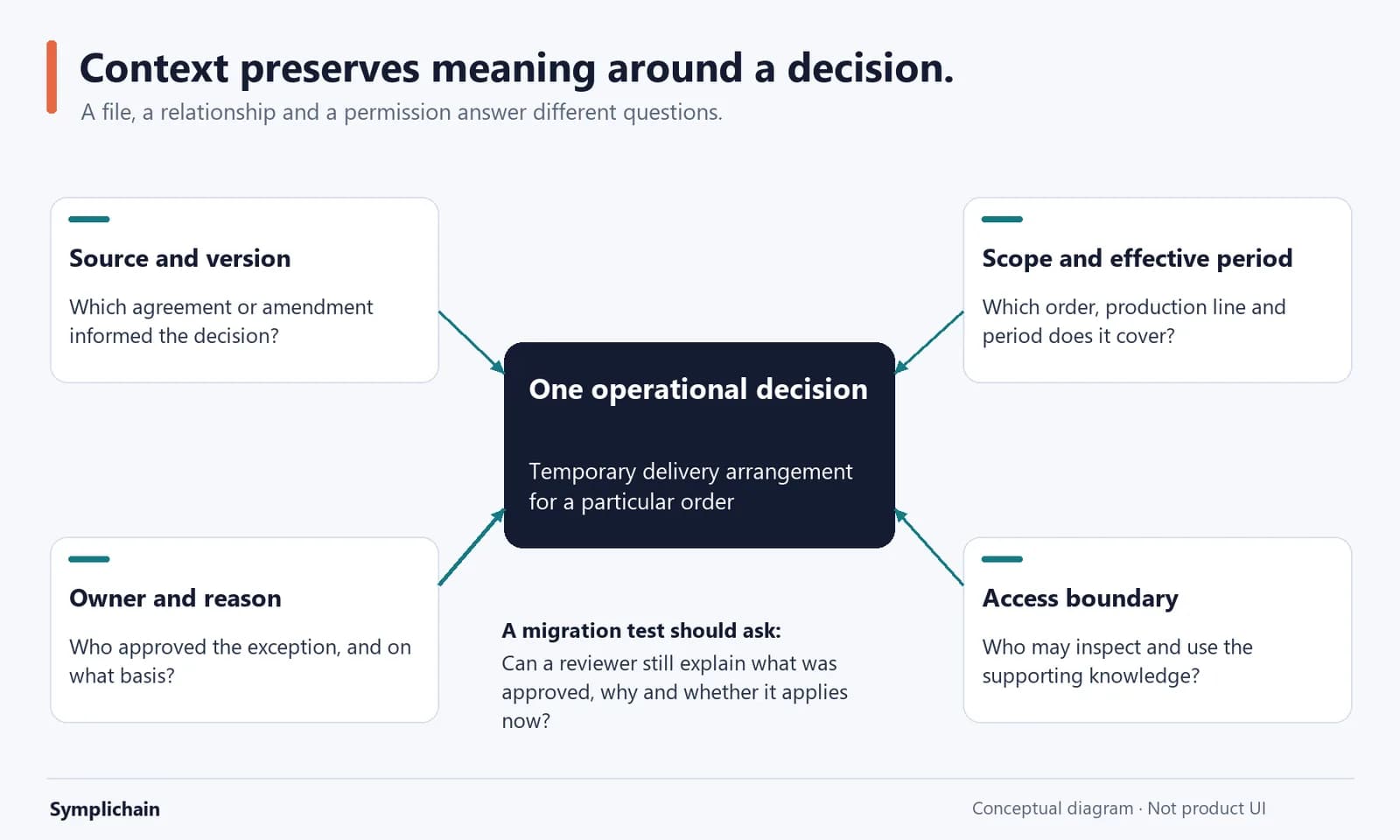
Conceptual context map. These relationships make a decision understandable; the representation and migration scope depend on the implementation.
SymContext™ provides the business context layer in Symplichain. In SymAI Ask™, the Context Library organises material into Organisation, Teams, Projects and Personal scopes, with availability depending on workspace access.
General mode supports research and writing without drawing on uploaded documents. Deep Context lets you select business sources for a question. Its Strict setting is designed to keep the response within the selected evidence.
For the temporary delivery arrangement, that might mean selecting the agreement, the relevant approval and the current production requirement. The person asking can then inspect citations, their source excerpts and surrounding passages.
The important habit is to review what supports the answer. A citation helps you check a finding; it does not remove the need to establish whether the source is current, relevant and sufficient for the decision.
If the selected material cannot establish whether the arrangement still applies, the useful outcome may be a clearly identified gap and a question for the decision owner.
A system record may show the outcome of a decision without explaining the judgment behind it.
“Delivery exception approved” is not enough to guide the next case. “Approved for this order because the substitute was validated for this line” tells a future reviewer much more.
Symplichain’s broader Operations Graph is designed to relate operational records, documents and stakeholder decisions around the work they describe. Implementing those relationships requires mapping the organisation’s systems. The current Context Library and citation experience are distinct from that broader graph.
For your own operation, begin with one decision type. Decide which facts and reasons must be retained, where they come from and who keeps them current. That groundwork helps make context useful whether it informs an answer today or an agentic workflow later.
In the illustrative delivery scenario, the procurement team has three relevant items: the supplier agreement, an approval for one temporary arrangement and a new request to use that arrangement again.
The agreement establishes the normal requirement. The approval explains a limited exception. The new request raises a fresh decision. A useful context packet keeps those roles distinct.
Suppose the earlier approval says the substitute was acceptable for a particular production line during a maintenance period. The current order serves a different line. The fact that the same supplier and material appear in both cases does not establish that the earlier permission applies.
A helpful answer would surface the previous decision and its reason, identify the changed condition and explain what the available evidence cannot settle. The reviewer can then ask the appropriate owner whether the substitute is valid for the new requirement.
This is more useful than either ignoring the historical approval or treating it as a permanent rule. History can inform the decision without deciding it automatically.
The team should also be able to trace the explanation. Which passage defines the normal requirement? Where is the exception recorded? What connects it to the relevant order and period? Which source establishes the current need?
Those questions explain the value of relationships in operational knowledge. They help a person distinguish precedent from permission, and a proposed next step from an authorised one. They also provide a practical starting point for deciding which relationships an Operations Graph implementation needs to map.
A document may be available in a workspace without being the document that should govern the answer.
An unsigned draft, an approved procedure and a retired instruction can all be readable. They do not have the same authority. Similarly, a recent email may describe what someone wants to do without establishing that the change has been accepted.
When a recurring task depends on these distinctions, record them explicitly. Identify the source owner, approval status, effective period and the kind of decision the source can support. The needed detail will vary: a general research note does not require the same treatment as a supplier exception that could affect production.
Access is a separate consideration. A buyer may be allowed to inspect commercial terms while another colleague needs only a delivery commitment. Connecting both sources should not erase that distinction. Agree which material each role may use and how permission changes are reflected in the context available to them.
This separation helps the team diagnose a poor answer. Was the necessary source unavailable? Was an outdated source treated as current? Did the question include the wrong evidence? Or did the interpretation go beyond what the selected material supported?
Changing the model alone will not resolve every one of those problems. Context needs its own review and maintenance process.
The freedom to move context should be discussed before the business depends on it.
Symplichain’s Portable Context principle is that the knowledge built from your tools belongs to your enterprise and can move when you choose. Export scope and destination requirements should be agreed during the technical discussion.
Use a representative case to make that discussion concrete:
- Identify the source material, relationships, decision history and access information the case depends on.
- Agree which of those elements the export contains and how they are represented.
- Ask how a destination can read and reconstruct the relevant context.
- Check whether a reviewer can trace the same decision back to its sources after the move.
- Identify what needs remapping, rebuilding or separate handling.
This is a suggested evaluation exercise, not a claim that every destination supports the same structures. A usable migration may require work at both ends. Exporting documents alone may also leave behind the relationships that explain them.
Portability is easiest to evaluate through a specific business question. After moving a representative case, can a reviewer still determine what was approved, why it was approved and whether it applies now?
To answer that, examine the handoff at three levels.
The material: Can the destination read the documents and records in a usable form? Can it identify versions and follow references back to the relevant source? An exported file with an unfamiliar identifier may still need a mapping that makes it meaningful.
The relationships: Can the next environment recognise that an amendment belongs to a particular agreement, or that an approval applies to one order? It may support different structures, so agree which relationships can be reconstructed and which require adaptation.
The controls: Can the intended people use the knowledge while restricted material stays within its access boundary? Permissions may need translation between systems rather than a simple copy. Agree who verifies the result before the migrated context is used for important decisions.
Also establish the transition point. If records continue changing while context is being moved, define how those changes are included and which environment is authoritative during the handover. A migration plan that ignores ongoing work can leave reviewers with two plausible versions of the truth.
These questions make ownership useful in practice. They do not require every platform to implement context identically. They require an honest account of what travels, what must be rebuilt and how the business will recognise a successful move.
Operational knowledge changes. Agreements are amended, people change roles and temporary instructions expire.
Give important context an owner and a review trigger. A new amendment should prompt a version check. A changed access role should prompt a permission check. A recurring question that produces conflicting answers should prompt an investigation of the underlying sources.
In the delivery example, the team should be able to distinguish “this was allowed then” from “this is allowed now.” Retaining history and establishing current authority are related responsibilities.
The same discipline applies when context travels. A migration should preserve useful history while making it clear which instructions remain active. Moving stale or overly broad knowledge simply transfers the problem.
Portable Context connects model choice with continuity. When your team changes intelligence, it should be able to keep using its approved business knowledge. When it introduces execution, the workflow should have evidence behind its proposed actions.
That is the connection to Open Intelligence and Unified Execution: context makes the answer specific to your business and gives the next step a basis for review.
Choose one recurring decision where people spend time reconstructing the history. Bring its documents and decision path to a Symplichain demo to explore source selection, evidence review and the context your team wants to retain.
Documents are one part of it. Useful operational context can also include relationships, source versions, decisions and reasons. Agree what an export preserves and what a destination can reconstruct.
No. It is designed to constrain the response to selected evidence. Reviewers still need to check the cited passages and whether the material supports the decision.
No. The library and citation experience are distinct from the broader graph. An Operations Graph implementation requires mapping relationships across the organisation’s systems.
- Procurement
- Portable context