A supplier moves a delivery date. The order still shows the original commitment. Planning needs to know whether production is affected, procurement needs a credible recovery option, and the customer team needs an answer it can stand behind.
AI can summarise the supplier’s email. But what would it need to help carry this work through?
It needs suitable intelligence, the business context behind the change, and a controlled way to act across the systems involved. At Symplichain, we call those foundations Open Intelligence, Portable Context and Unified Execution.
Together, they define how we are building the agentic execution layer for supply chain: choose your intelligence, own your context, and connect decisions to tracked actions.
Consider an illustrative delivery-change scenario. A supplier says an order will arrive later than planned. The message alone does not tell you whether to accept the change.
You need the production requirement, available inventory, the supplier agreement and any previous commitments. You also need to know who can approve a replacement and where the decision should be recorded.
The same event therefore creates three questions:
| Question | Pillar | What it means for your team |
|---|---|---|
| Which intelligence fits this task? | Open Intelligence | Choose models around the work and your constraints. |
| What does AI need to understand? | Portable Context | Use business knowledge that remains under your control. |
| How does the decision become completed work? | Unified Execution | Coordinate supported actions, approvals and evidence across systems. |
These are connected requirements. A capable model can still use the wrong agreement. Complete context can still produce a recommendation that nobody acts on. A connected workflow can still move too quickly if its permissions are unclear.
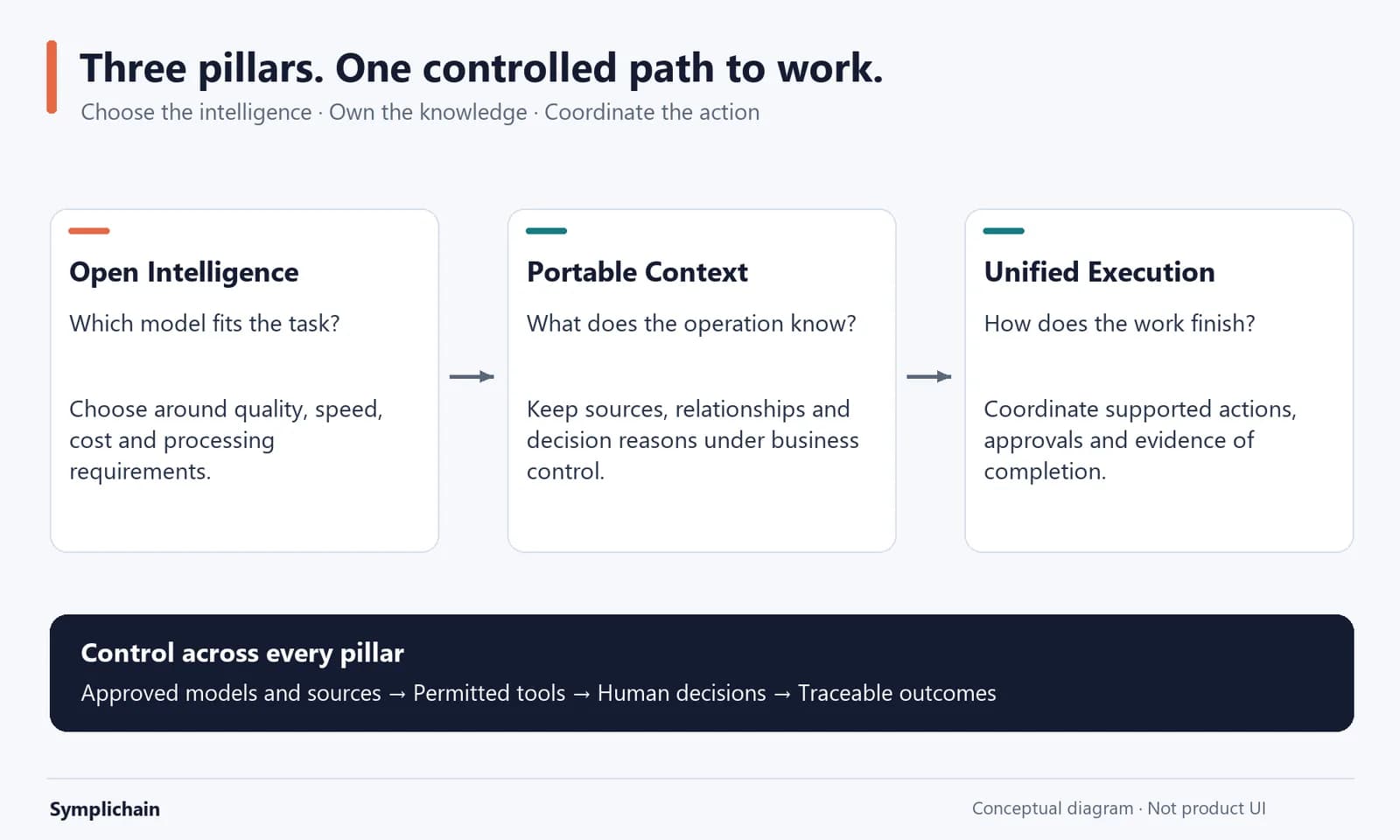
The three pillars work together: model choice, business knowledge and controlled action each answer a different operational question.
An AI model is the engine that interprets information and produces a response. Different models can suit different jobs.
A short supplier update may call for speed. Comparing an agreement with several amendments may require a more demanding review. In either case, the answer must meet your team’s quality and data-handling requirements.
Open Intelligence means keeping the freedom to choose and change that intelligence layer. It does not mean every model is equally suitable or approved for every source.
In Symplichain, SymModels™ provides model options, while SymRouter™ handles selection. SymAI Ask™ groups available options into Fast, Balanced and Advanced bands and shows the model, response time and estimated cost alongside the answer.
That visibility helps you ask a better question than “Which model is best?”: Which available model produces a useful, reviewable result for this task? Important work should be evaluated before a different model becomes the default.
The value of an operational answer often depends on information specific to your business.
An order has a required date. A contract has a current amendment. A previous exception has a decision and a reason. The relationship between those facts matters as much as the files themselves.
Portable Context is our principle that this operational knowledge belongs to your business and should remain useful as your technology choices evolve.
SymContext™ organises business material and supports answers grounded in selected sources. In SymAI Ask™, the Context Library has Organisation, Teams, Projects and Personal scopes. Deep Context lets you select material for a question; citations let you inspect the supporting passage.
The broader Operations Graph connects records, documents and decisions around the work they describe. That requires mapping relationships across an organisation’s systems; it is distinct from the current library and citation experience.
Portability should also be concrete. Before adopting a platform, agree what can move, which relationships and permissions travel with it, and what a destination needs to use it. An export is valuable when the knowledge remains understandable afterwards.
Accepting a new delivery date may affect an order record, a planning decision and a customer message. Completing one update does not automatically complete the case.
Unified Execution is our approach to keeping those steps connected, with clear owners, permitted actions and a visible outcome.
SymFlow™ provides connections, governance and observability. SymMirror™ is the agentic workflow family. SymConductor™ coordinates workflow steps and the points where a person must decide.
For the delivery-change example, a defined workflow could gather the relevant records, identify the impact, prepare the next step, pause for approval and carry an authorised update into a supported system. It should then check whether the update succeeded and preserve anything still unresolved.
Supported operations and approval behaviour are confirmed for each implementation. A connection to a system is not blanket permission to change it.
The freedom to choose models, build context and introduce agents brings practical decisions about access and responsibility.
SymTrust™ defines the governance boundary around models, context and tools. SymPulse™ provides visibility into AI activity, cost, performance and workflow steps. Their roles work together: a record of an action helps you investigate it; a policy determines whether it should be allowed in the first place.
Start with one recurring task. Identify the required sources, acceptable output, decision owner and definition of completion. Then test all three pillars against that task, including where the workflow should wait or stop.
Bring that workflow to a Symplichain demo. We can explore the intelligence it needs, the context behind it and the supported path from a decision to action.
Open Intelligence means model choice around the task. Portable Context means business knowledge remains under your control. Unified Execution means decisions lead to coordinated, tracked actions in supported systems.
Symplichain is designed to work across existing systems. The sources and operations available for a particular workflow depend on its integrations, access and implementation.
No. An agentic workflow can gather evidence and propose actions while keeping defined decisions with people. Its permissions and approval boundaries should be explicit before it runs.
- Planning
- Procurement
- Logistics
- Portable context
- Model routing
- Coordination