A buyer needs a quick explanation of a supplier’s message. Later, the same buyer needs to compare an agreement with its amendments before recommending a change.
Both tasks involve AI. They do not have the same requirements.
The first may prioritise a clear answer with little waiting. The second needs careful use of the right documents, traceable findings and a reviewer who understands the commercial consequences.
Open Intelligence means having the freedom to choose and change AI models around those requirements. At Symplichain, it is one of our three platform pillars, alongside Portable Context and Unified Execution.
The aim is a useful result under your constraints, with enough visibility to judge it.
An AI model interprets information and produces an output. A model’s reputation or benchmark score can help you shortlist options, but your operation still needs its own acceptance criteria.
Consider an illustrative procurement review. A supplier has sent a revised agreement. The buyer wants to know which terms changed and which changes require discussion.
A useful response should distinguish the original agreement from the amendment, identify the relevant passages and flag anything the selected material cannot establish. A fluent summary that merges old and new terms would fail the task.
For a routine status message, the acceptance criteria would be different: identify the changed date, preserve uncertainty and avoid introducing a commitment the supplier never made.
Write those criteria before comparing models. Otherwise, speed, confidence or polished wording can become a substitute for correctness.
| Question | What to decide |
|---|---|
| What must the output get right? | Required facts, source support and the errors that would make it unusable. |
| How long can the task wait? | Whether it is an immediate lookup, an everyday review or a deeper investigation. |
| What information may be processed? | Approved sources, providers and processing arrangements. |
| What does a usable result cost? | Model usage plus the human effort needed to check and correct it. |
A low-cost answer that repeatedly needs rewriting may be expensive in practice. A more capable model may also be unnecessary for a simple task. Compare the complete effort needed to reach an acceptable result.
Data constraints belong in this decision from the start. An open-weight model does not, by itself, mean your data stays on your hardware. Model licensing and deployment location are separate questions.
SymModels™ is the model layer: it provides available options from multiple providers. SymRouter™ is the selection layer: it helps choose an option for the task.
In SymAI Ask™, models are grouped into Fast, Balanced and Advanced bands. You can choose from the options available in your workspace, select a band, or use automatic selection. The returned answer shows its model, response time and estimated cost.
These controls answer different questions from response depth. A model band concerns the model choice. Brief, Standard and Deep Research are separate controls for General responses.
Automatic selection is a useful starting point, rather than proof that the output is the best possible answer. Review the response against the task and its sources. The displayed estimate is also a response-level usage estimate, rather than a complete billing statement.
Within agentic workflows, model selection can be applied to individual steps. The routing options and processing constraints available are confirmed for each implementation.
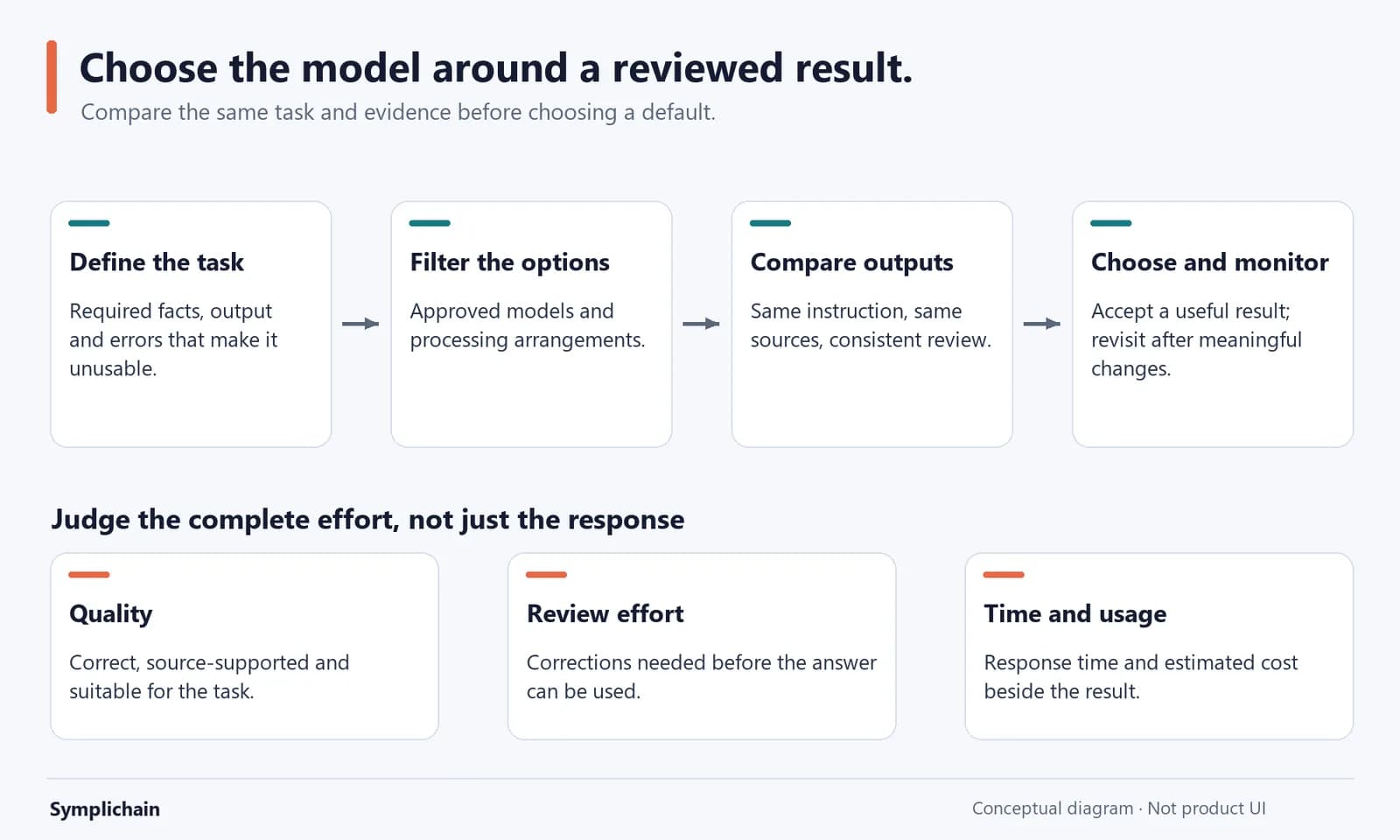
A practical evaluation path. Compare the same task and evidence, then judge the complete effort needed to reach a reviewed result.
You do not need a large benchmark programme to begin. You need representative work and a consistent review.
Choose a small set of tasks your team actually repeats. Include straightforward examples and difficult ones: an incomplete supplier response, conflicting dates, or an amendment that changes only one clause.
Give the available models the same instruction and source material. Then have a person familiar with the work check:
- Whether required facts are correct and supported by the selected evidence.
- Whether the response follows the requested format and identifies missing information.
- How much correction is needed before the output can be used.
- Response time and the displayed usage estimate.
Keep the result with the task, model and review notes. This gives your team a reason for its choice that can be revisited when the work or available models change.
For consequential tasks, expand the evaluation before making a new model the default. Passing a few supplier summaries does not establish suitability for agreement reviews or system updates.
To see why this matters, return to the illustrative procurement review. The buyer has an original agreement, a later amendment and a supplier email referring to the new terms. The question is: “What changed, and what should I discuss with the supplier?”
The team first defines the required answer. It should identify changed clauses, distinguish them from unchanged terms, cite the supporting passages and list any questions the documents leave open. It should not silently turn an ambiguous email into an agreed contractual change.
The reviewer prepares the same source packet for each available model. This matters because an apparent difference in model quality could simply reflect different evidence. A response using the amendment cannot be fairly compared with one that received only the original agreement.
Imagine one output is concise and identifies the change correctly, but leaves out its effective date. Another includes the date and source passage, but treats the supplier’s email as permission to update the supplier record. The reviewer would record different failures: incomplete evidence in the first response, and an unsupported next action in the second.
Neither result should be accepted just because it sounds professional. The useful comparison is whether each response meets the agreed requirements and what work remains before a buyer can rely on it.
The team may decide that one model is suitable for an initial summary while another deserves further testing for detailed review. It may also discover that the instruction needs improvement: explicitly ask for effective dates, unresolved questions and a separation between findings and recommendations.
That is a valuable result from evaluation. The goal is to improve the task as a whole, rather than force every weakness into a model ranking.
A response-level estimate makes usage visible, but it captures only part of the effort required to finish a business task.
If a reviewer must reopen every document, reconstruct omitted details and rewrite the answer, a cheap response can leave much of the original work untouched. A more expensive response may be worthwhile when it consistently reduces that effort without weakening the quality standard.
Keep a simple review record alongside the model metadata. Did the output need no material correction, a small correction or a substantial rewrite? Was a missing citation merely inconvenient, or did it prevent the reviewer from checking an important claim? Did the response acknowledge uncertainty, or did the reviewer have to discover it?
These observations make the tradeoff concrete without requiring an elaborate financial model. For a recurring task, compare the time and effort needed to reach a reviewed output. If you later estimate a monetary benefit, state the assumptions and keep released capacity separate from cash savings.
The same thinking prevents overspending. If two available models meet the task’s standard and require similar review, response time and usage cost become more meaningful comparison points. A demanding agreement review and a routine supplier-message summary can then have different defaults for understandable reasons.
The freedom to switch is useful; the decision to switch still deserves a process.
Before introducing a new default, keep examples of acceptable outputs and difficult cases. Run the replacement against those cases using the same sources and requirements. Pay attention to changes in formatting, interpretation, uncertainty and any proposed tool use, as well as factual accuracy.
For a knowledge task, the consequence may be additional review work. For a workflow step, a changed interpretation could alter what gets proposed to a decision owner. Test the parts of the process that depend on the model’s output, including the cases that should stop for clarification.
Assign someone to accept the change and decide how it will be monitored. A small, defined rollout can show whether the replacement works in practice before it becomes a wider default. If important failures appear, the team needs a supported way to return to an approved configuration or pause the affected task.
These are suggested rollout practices, not a promise that every workspace provides automatic model fallback or version rollback. Confirm the controls available in your implementation. Open Intelligence creates room to adapt; evaluation and governance make that adaptation deliberate.
Model choice becomes more useful when your context is organised separately from a particular model.
In the procurement example, you want to compare responses using the same agreement and amendment. Rebuilding the evidence packet each time would make comparison harder and introduce another opportunity for mistakes.
SymContext™ supplies the business material behind the task. The relationship is straightforward: SymModels™ provides options, SymRouter™ handles selection, and SymContext provides the selected knowledge those options need.
That separation supports continuity when you change models. It does not promise identical behaviour: models can interpret instructions differently, produce different answers and behave differently with tools. Keep evaluations and approval rules in place as the intelligence changes.
Open Intelligence is most valuable when your team knows which choices are permitted and why.
SymTrust™ provides the governance perspective around models, information and tools. SymPulse™ provides visibility into use, response time, estimated cost and workflow activity. Together, those perspectives help a team investigate a poor result and decide whether to change the model, the sources, the instruction or the workflow.
Sometimes the model is not the problem. If the current agreement was never supplied, choosing a different engine may simply produce a different answer from the same incomplete evidence.
Start with one recurring question and define what a useful answer must contain. Bring that question and representative material to a Symplichain demo to explore the available model choices and how to compare them.
No. It describes freedom to choose and change the intelligence layer. Options may include proprietary frontier models, open-weight models and domain models, depending on the workspace and implementation.
No. Evaluate the returned output against your task. Automatic selection does not establish that a model will produce the best result for every question.
Discuss your own-model or provider-key requirements with Symplichain. The supported arrangement, data handling and available controls need to be confirmed for your deployment.
- Procurement
- Model routing